memory.span: how many things can you hold in your head?
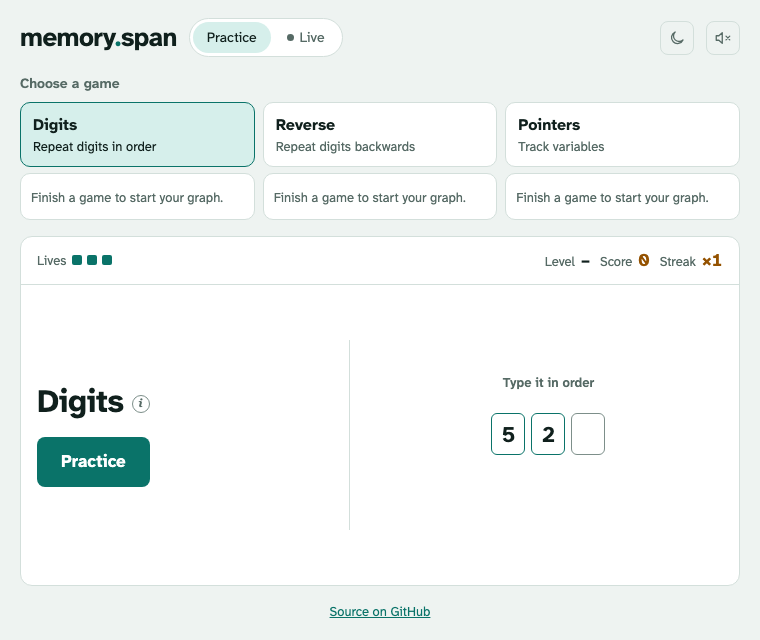
memory.span is a small game that finds how many things you can hold in your head at once. Digits flash one at a time, and you type them back. Each right answer adds one more. The longest sequence you get right is your span.
Why I made it
While working through zipper lists, I kept losing
track of which pointer pointed where. current_1, current_2, next_1, tail: after three
or four of them I would forget one and the loop would go wrong. I wondered how many I could
actually hold, and whether I could train it.
Three games
- Digits. Digits flash one per second; type them back in order. This copies the standard digit-span task. Most adults land between 5 and 8.
- Reverse. The same, but type them backwards. It’s harder: most adults land between 4 and 6.
- Pointers. Lines like
a = 4,b = a,a = 9appear one at a time, then you give the final value of every variable (here, a is 9 and b is 4). This is the one I made the game for, because it is the closest to tracing pointers in a linked-list loop. There are no published norms for it, so the leaderboard is the only yardstick.
You have three lives per game. A miss costs one, and right answers in a row build a streak that multiplies your points. The start screen plays a short demo of the game you pick, so you can see what to do before you press start.
Practice or Live
A switch next to the title picks how you play.
- Practice runs entirely in your browser. Nothing is sent anywhere, and a small graph under each game tracks your progress.
- Live puts your games on a public leaderboard, with a tab per game and a Total tab that adds up each player’s best in every game. The first time you play Live you get a random nickname, such as “Swift Otter 42”, which you can keep or change.
Keeping the leaderboard honest
A leaderboard is only fun if the scores are real. If the browser made the rounds and checked the answers, anyone could open the developer tools and post a span of 40. So a small Cloudflare Worker does both jobs:
- The server creates every round and keeps the answer. The browser only gets the sequence it has to show.
- An answer that arrives before the sequence could have finished showing is refused.
- At most 60 games per player per hour.
- Nicknames must be unique, are filtered for offensive words, and can’t be near-copies of another player’s name. “Swift Otter” and “swift_0tter” count as the same name.
It can’t stop a bot that watches the screen and types the digits back, and no memory game in a browser can. But it does mean nobody can just make up a score.
A few small things
- End a game early. Press Esc or click End game. In Live, the game counts with the score you had so far, so quitting can never raise a score.
- Light and dark, sound on or off, and a still picture instead of the demos if your system asks for reduced motion.
- Not a clinical test. Digit span is a real measure of working memory, but this is a game, and scores move by about one level from day to day. Sleep and coffee count.
What’s next
Once each game has about 30 Live players, your progress panel will say how you compare, for example “Your best span 7 beats 68% of players”. After that, an optional age bracket, so you can compare with people your own age.
Try it
Play memory.span. It’s free, there’s nothing to install, and the source is on GitHub.